
The most sought after exam for aspiring probationary officers will be held on Sunday, April 28.

Price correction over post-election peaks could throw disinvestment calculations awry.

Non-Performing Assets are a wake-up call for public sector banks.

Punjab National Bank is the second largest PSU bank, in which government holding is 58.87 per cent.

Stocks of public sector companies, especially the oil refining and marketing companies (OMCs) - Bharat Petroleum Corporation Limited (BPCL), Hindustan Petroleum Corporation Limited (HPCL) and Indian Oil Corporation Limited (IOC) - logged gains on Tuesday in a weak market. While the Nifty lost nearly 1 per cent in trade on Tuesday, the Nifty CPSE index - a gauge of performance of central public sector enterprises on the National Stock Exchange (NSE) - gained over 3 per cent in intra-day trade. The rally in PSU stocks comes on the back of the BPCL chairman, Arun Kumar Singh suggesting in the company's annual general meeting (AGM) on Monday that the government intends to complete the divestment process in the OMC by March 2022.

Conducted by research firm IDC, the study titled 'Understanding the Indian Retail Banking Customer' says push marketing is fast becoming obsolete and the thrust should be on creating brand advocates.
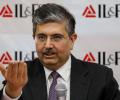
'I find the RBI edict to the Kotak Mahindra Bank to reduce Uday Kotak's shareholding very unreasonable,' says Sudhir Bisht.

Foreign brokerages said if SBI decide to buy stake in the bank, they should buy it at Rs 1 per share as the net worth is hugely impaired.

'Inter-ministerial coordination, information on the proposed PSUs, and due diligence are taking longer than expected to conclude the process.'

The financial position of India's public sector banks (PSBs) has deteriorated sharply over the past financial year.

Finance Minister Arun Jaitley said that at a time when the private sector has been somewhat conservative in investments, public investment always takes the lead.

In August, the Reserve Bank of India Governor Shaktikanta Das held a meeting with chief executive officers/ managing directors (CEOs/ MDs) of large non-banking financial corporations (NBFCs). The discussions included diversifying borrowing sources for NBFCs and housing finance companies (HFCs) to contain increasing reliance on bank borrowing, risks associated with high credit growth in retail segment in unsecured loans, prioritising IT upgrades and cyber-security, improving provisioning, monitoring of stressed exposures and slippages, ensuring robust liquidity and asset-liability management, ensuring transparency in pricing, creating robust grievance redress mechanisms.
Two public sector banks, Union Bank of India and United Bank of India (UBI), on Monday cut lending rates by 25-50 basis points (bps) ahead of Finance Minister P Chidambaram's meeting with PSU bank chiefs.
Mangalore-based Corporation Bank is considering merger of its housing finance arm Corporation Bank Homes with itself.
The government on Monday said that its mantra for banking reforms would be 'consolidation, competition and convergence' to enable PSU banks to become more stronger, bigger and globally competitive.

It is to keep labour unions away and make the employees feel important.

Jefferies has identified 11 stocks set to benefit from long-term macro trends like capital expenditures, government manufacturing initiatives, and financialisation.

His statement assumes significance in the light of scams in the state-owned banks.

Credit-to-deposit (CD) ratio of major public sector and private sector banks during the October-December quarter of FY24 inched up as compared to the previous quarter though government-owned lenders reported a lower rate than their private peers. CD ratio is the ratio of the funds that banks lend as compared to the funds raised in the form of deposits. The CD ratio of top public sector banks (PSBs) - State Bank of India, Punjab National Bank, Bank of Baroda and Canara Bank - was lower than their private counterparts.

The Budget proposals are expected to boost the fortunes of consumer goods and fast-moving consumer goods companies, which have been struggling with poor consumer demand for more than a year. The Budget announcements, such as the increase in standard deduction by Rs 25,000 for income-tax payers and slab revisions, will put more money in their hands, boosting consumer demand. Private consumption is also likely to benefit from a new scheme to offer internships to 10 million youths in the country's top 500 companies.

Despite multiple headwinds at the start of 2023, the Indian markets delivered a strong performance, posting 19-20 per cent growth for the year. Even as new records were set, investor sentiment remains strong going into 2024, given the lower inflation, expectations of steady to lower interest rates, higher economic growth, and strong inflows. However, the overriding concern for most brokerages is valuations.

Indian stock markets are expected to be driven mostly by global factors this week amid a lack of local triggers and earnings season largely coming to an end, say analysts. Crude oil prices, rupee movement and US Federal Reserve meeting minutes to be released this week will also influence the market sentiment. "With the earnings season behind us, global cues would largely dictate the trend in the coming week," Ajit Mishra, SVP - technical research, Religare Broking Ltd, said.

Cash-strapped Kingfisher Airlines owed over Rs 5,600 crore (Rs 56 billion) to public sector banks as on February this year.

A number of non-banking financial companies (NBFCs) have tapped into the debt capital market ahead of the festival season to meet increasing credit demand as bank funding slows. On Tuesday, Aptus Value Housing Finance secured Rs 300 crore at an interest rate of 8.75 per cent through bonds maturing in five years. ICICI Home Finance Company turned to the market to raise Rs 275 crore at 7.94 per cent, alongside another Rs 300 crore at 7.95 per cent, through bonds maturing in five and three years, respectively.

Sensex, Nifty end the day in red on unfavourable cues from global markets.
Punjab National Bank is believed to have clinched the deal for taking over the ailing Industrial Finance Corporation of India.

Equity benchmark Sensex slumped 400 points on Wednesday tracking losses in index majors HDFC twins, Kotak Bank and TCS amid a weak trend in global markets.
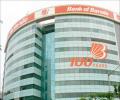
The Finance Ministry has invited private sector bankers.
Credit rating agency ICRA has said that mergers are one of the best options for growth of Indian banks but warned that it may not solve some "basic problems" of Indian banks plagued by inferior asset quality, poor management and lack of autonomy.\n\n\n\n

Bajaj Finance was the top laggard in the Sensex pack, skidding over 2 per cent, followed by Kotak Bank, Nestle India, HDFC, M&M and ICICI Bank. ONGC was the top gainer, rallying around 8 per cent. NTPC, Asian Paints, Tech Mahindra, PowerGrid and IndusInd Bank were among the other winners.

Though most experts remain bullish on the banking space, they suggest investors buy only those banks whose NPAs are at a manageable level of 3% to 4% and there is credit growth or earnings visibility.

The other prominent gainers were Tech Mahindra, HCL Technologies, Wipro, State Bank of India and Larsen & Toubro. Bajaj Finserv, Power Grid, UltraTech Cement and HDFC Bank were among the laggards.
Recpaitalising banks through taxpayers' money will not solve the NPA problem.

Banks are in need of government support to manage the stressed assets
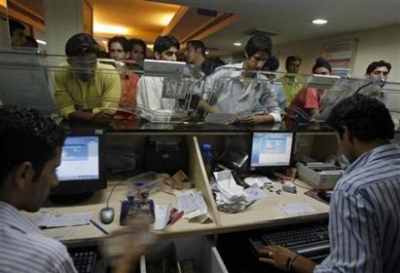
Analysts, however, said the timing of the infusion was good.

'They are ideal for short-term financial goals like children's education or a down payment for a house.' 'They are also useful for transitional savings, such as during job switches or while starting a business.'

Top gainers in the Sensex pack included Tata Steel, Kotak Bank, NTPC, HDFC twins, PowerGrid and ONGC, rising up to 4.60 per cent.

The S&P BSE Sensex and the Nifty50 have hit record highs amid the poll outcome-triggered bull frenzy at the bourses. Most analysts feel that the indices are on course to rise further over the next few months - till the general elections - albeit amid intermittent corrections - largely triggered by global developments. Bharatiya Janata Party's (BJP's) win in the three state elections of Madhya Pradesh (MP), Rajasthan and Chhattisgarh, analysts at Jefferies believe, reinforces the consensus expectations of a Modi win 2024 national elections with a greater likelihood of over 300 seats for the BJP.
